
Readiness, Nordics, and Networks
Hello,
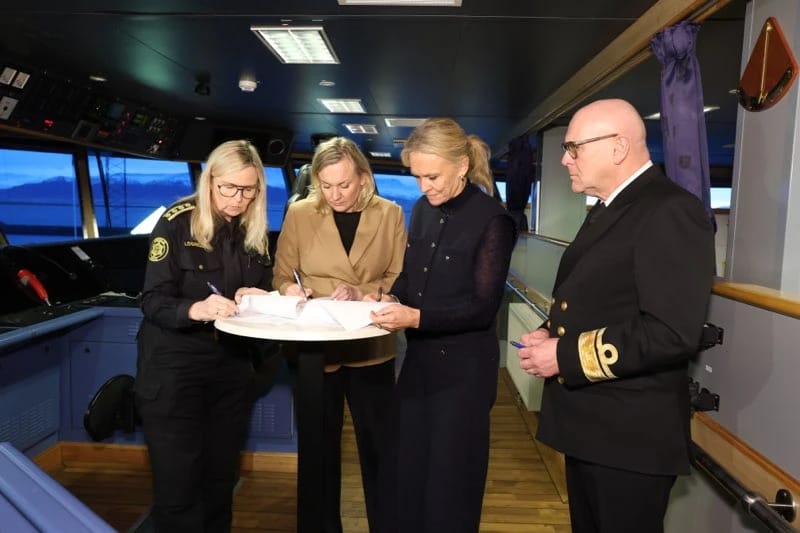
The government signed agreements aboard the patrol vessel Þór to strengthen the Coast Guard and the police. Days earlier, the Coast Guard’s director had warned of a cut of about ISK 900 million. Abroad, the Nordic states have begun work on a defence agreement, and Reykjavík is weighing visa curbs on Russians. At home, a cyberattack took down a large web host, a Microsoft outage reached the cabinet table, and households stocked up for a crisis.
Ministers sign capability agreements with a Coast Guard facing cuts
The foreign and justice ministers signed agreements on 25 November to strengthen the Coast Guard’s and police’s surveillance and response capability. No sums were published; the Coast Guard expects about ISK 900 million less next year.
Aboard the patrol vessel Þór on 25 November, after a National Security Council meeting held there to mark the Coast Guard’s centenary, the foreign and justice ministers signed agreements with the Coast Guard and the National Commissioner of Police to strengthen their surveillance and response capability, with emphasis on unmanned aircraft and on specially equipped vehicles for the police special unit. “Given developments in world affairs, and as recent examples show, falling behind is not an option,” the foreign minister said. The release gives no sums. Four days earlier, the Coast Guard’s director had said its appropriations would fall by about ISK 900 million next year, against direct funding of about ISK 8.2 billion this year, and that some cuts were certain if nothing changed. It keeps one patrol vessel at sea on average, and with three helicopters it has the two needed for rescues beyond 20 nautical miles ready about 65% of the time. On 20 November, RÚV reported that after a fault in one helicopter’s winch, the Coast Guard had stopped hoisting from all of them for nearly two weeks.
The Coast Guard answers to the justice ministry but carries out its security and defence tasks under a service agreement with the foreign ministry that is renewed each year, a term the director considers too short for the five-year plan it is drawing up. He wants the review of the 2006 Coast Guard Act, now beginning, to clarify its remit and write the defence role into law. Asked whether the Coast Guard and the National Commissioner of Police might be one body, he did not rule it out, but said a merger could complicate cooperation with Norway, Denmark and other neighbours, which keep their coast guards or navies separate from the police. How defence tasks are to be divided between ministries is still unsettled, he said, and the ships, radars, communications and trained staff already in place should be used together: “This is a national security issue, plain and simple.”
Nordic states start work on a defence cooperation agreement
The five Nordic states agreed in Oslo on 12 November to draft an agreement giving their defence cooperation a legal framework. Two days earlier, the ten states of the UK-led Joint Expeditionary Force (JEF), Iceland among them, signed an initiative to integrate their navies.
The five Nordic states, meeting in Oslo under Nordic Defence Cooperation (NORDEFCO), agreed on 12 November to “start the process of developing a Nordic Defence Cooperation Agreement”. The foreign ministry says the agreement will sharpen the legal framework of Nordic defence cooperation and strengthen its contribution to NATO’s collective defence. Björn Bjarnason, a former justice minister, writes for Varðberg that the development matters to Iceland chiefly because North Atlantic defence is tied to Nordic defence. The vision for Nordic defence cooperation to 2030, adopted by the five states in Tórshavn in April 2024, puts weight on host-nation support, transport and civilian infrastructure. That, he argues, ties the cooperation directly to Iceland’s role in collective defence.
The ministry’s release also reports that the heads of the navies of the JEF countries met in Oslo the same week and confirmed closer maritime cooperation. On 10 November, aboard HMS Prince of Wales, all ten JEF states signed a Northern Navies Initiative. The partners are to train to one standard, plan together before a crisis and pass into NATO command should the Alliance mobilise at scale; the initiative is also aimed at attacks on undersea cables and other seabed infrastructure.
Iceland weighs visa curbs on Russians after plot in Denmark
Iceland is looking at restricting visas for Russians, the foreign minister says. She spoke after Danish intelligence said Russian intelligence was behind a plot to kill a Ukrainian-American rapper near Copenhagen.
Denmark’s Security and Intelligence Service (PET) said on 20 November that Russian intelligence was behind a plot to kill the rapper Kyivstoner, who was to play a concert outside Copenhagen in September. Denmark expelled Russia’s defence attaché and asked EU states to end tourist visas for Russians across the Schengen area, of which Iceland is part. Foreign Minister Þorgerður Katrín Gunnarsdóttir told RÚV the plot reflects “a very serious and deteriorating security situation” and that the government is looking at whether to restrict visas for Russians or take similar steps, “in cooperation with our main allies, and of course we look first and foremost to the Nordic countries”. Russia’s influence in Iceland, she said, “is both direct and indirect, and we need to be vigilant just like others”. Moscow aims to sow fear and weaken European unity and support for Ukraine, she said, and the government is examining every way to curb its ability to exert influence. At home it has strengthened cyber security, including CERT-IS, the national incident response team, and is building cooperation and capability “to meet these threats now facing us”.
Attackers take down Icelandic web host and destroy pro-Palestinian sites
A cyberattack on 20 November shut down 1984 ehf., which hosts a large share of Iceland’s websites and email, and destroyed sites supporting the Palestinian cause. CERT-IS says it is too early to tell whether a criminal group or a state-sponsored group was behind it.
Attackers broke into the web host 1984 ehf. on 20 November, and the company shut down all its services, affecting tens of thousands of customers. Their initial aim, the company said the next day, appears to have been to take down websites supporting the Palestinian cause; seven were destroyed before the company stopped them. Its managing director says an attack of this scale is probably within reach only of a state actor, but that it may never be known who was behind it.
The head of CERT-IS says it is too early to draw conclusions. The case is with the National Commissioner of Police; CERT-IS is examining whether a capable criminal group or a state-sponsored group was behind it and has asked foreign sister agencies for information. With AI, he said, an attack that would normally take weeks took a few hours, and the attackers’ footprints are harder to trace. CERT-IS and the government’s IT service centre received access to a specialised OpenAI cyber-defence model on 4 November, and on 12 November a researcher at Defend Iceland called for raising Iceland’s alert level for cyber threats after an AI tool the firm built found weaknesses in thousands of Icelandic computer systems.
Microsoft outage reaches the cabinet table
A worldwide Microsoft 365 outage on 12–14 November was on the cabinet’s agenda. CERT-IS warned against relying too heavily on one provider.
A worldwide outage of Microsoft 365 on 12 to 14 November was on the cabinet’s agenda on 17 November at the finance minister’s request. State institutions have run Office 365, email included, under a framework agreement with Microsoft since 2018, and Icelandic businesses rely on Microsoft “in 98% of cases”, Advania’s head of cybersecurity told RÚV. Most government email runs in cloud services abroad. Its contingency plan, the government has told Alþingi, covers two scenarios: a cut to the subsea cables and a total loss of foreign connections, in which a local mail system would be rebuilt from backups held in Iceland. November’s outage was of a different kind: the provider itself failed. It showed the importance of not relying too heavily on one provider, CERT-IS said. What digital sovereignty actually entails has not been formally defined by either Alþingi or the government.
Households stock up after civil protection booklet
Sales of matches, rice and radios jumped after the civil protection booklet Verum viðbúin came out on 3 November, and older people took out cash.
The household guide Verum viðbúin (Let’s be prepared), covered in Briefing #10, has changed buying habits quickly. Sales of matches at the supermarket chain Bónus rose 200%, and of rice and tinned food 100%, after it came out, the chain said; at the electronics retailer Elko, sales of the small radios the booklet recommends rose by more than 300% on a year earlier, and of batteries by 30%. Civil protection had told retailers in advance that the booklet was coming, its head told RÚV. Older people in particular withdrew cash, some of them large sums, which the booklet also recommends keeping. After one of the big banks alerted civil protection, civil protection advised through the Reykjavík senior citizens’ association against keeping large amounts at home for long.
Justice minister resubmits civil protection bill
The justice minister has resubmitted, largely unchanged, a bill to replace the 2008 Civil Protection Act. The new version adds an emergency power for the National Commissioner of Police and an inquiry committee.
The justice minister moved a bill for a new Civil Protection Act on 9 November, largely unchanged from the version that failed to pass last session. It adds a fourth and highest alert level to the 2008 act, þjóðarvá (national emergency), declared by the Prime Minister. Ministers must designate essential infrastructure. For military threats, the National Commissioner of Police sets the alert level in consultation with the minister responsible for defence, and the Coast Guard leads the civilian response at sea and in the air.
The resubmitted version adds three things. Once a danger level has been declared, the commissioner may take the measures needed to avert imminent damage; decisions such as raising protective barriers on the Reykjanes peninsula have so far rested on an uncodified doctrine of necessity. The minister may task the commissioner with temporary risk assessments for an area during a prolonged event. And an inquiry committee returns: the minister may appoint one, and must when someone dies or is seriously injured in connection with responders’ action or inaction. Alþingi’s previous committee was abolished in 2022 without having completed an investigation.
Teledyne Gavia earns ISK 1 billion from autonomous submarines
Teledyne Gavia, an Icelandic maker of autonomous submarines owned by a US group, made a profit of ISK 1.06 billion in 2025.
Teledyne Gavia, which designs and builds autonomous submarines, made a profit of ISK 1.06 billion in 2025 on revenue of ISK 5.07 billion, up 39.4%, Viðskiptablaðið reports. The submarines’ side-scan sonar maps the seabed and objects on it in fine detail, so the same submarine can survey the route for a new power cable or search the seabed along an existing one; navies use it to hunt mines and collect intelligence. Gavia systems have been bought by 18 navies, Sweden’s among them. In December 2025 the company handed the Coast Guard a submarine to strengthen surveillance of the undersea infrastructure around Iceland. Teledyne Gavia is wholly owned by the US firm Teledyne Instruments.
Iceland takes its Atlantic current concern to COP31
Iceland used COP31 to present a possible collapse of the Atlantic current system as a security risk, and raised its contributions to ocean monitoring. A government working group on climate tipping points is due to report soon.
Iceland put a possible collapse of the Atlantic Meridional Overturning Circulation (AMOC) before COP31 in Antalya, at an event it hosted with the Nordic Council of Ministers. The climate minister urged the Nordics to “approach climate change as a security threat”; Stefan Rahmstorf of the Potsdam Institute told the event that an AMOC shutdown is starting to look likely. Iceland will contribute annually to the Global Ocean Observing System through the EU-led OceanEye alliance and raise its contribution to UNESCO’s Intergovernmental Oceanographic Commission. The government referred AMOC risk to the National Security Council in autumn 2025, and in May the minister appointed a working group on tipping points to deliver proposals by 31 October. The ministry now says it will report soon.
Reply with any questions or comments, and please forward to anyone interested.
Get the next issue by email
Free, by email — sent every few weeks.
Thank you — your subscription has been received. A confirmation is on its way to your inbox.
Something went wrong — please try again or write to hallo@varda.org.